




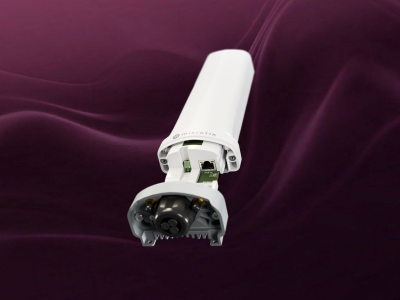

KNOT Gateway is MikroTik's outdoor IoT gateway that combines BLE, long-range sub-GHz connectivity, Wi-Fi, Ethernet, LTE and GNSS in a single rugged IP66 platform, built for integrators and companies that track assets, collect telemetry and connect sensors in warehouses, logistics terminals, industrial sites and remote areas. The gateway goes where the devices actually are — sensors, Bluetooth tags, remote meters — and brings their data back to where it is needed. It is available in two versions: KNOT Gateway LR8 with 868 MHz LoRa® (product code: L14G-2ax-BT5-LR8&EG800K, LTE bands for Europe) and KNOT Gateway HL9 with 915 MHz Wi-Fi HaLow IEEE 802.11ah (product code: L14G-2ax-BT5-HL9&EG800Q, LTE bands for North America).
With Bluetooth 5.1, KNOT Gateway turns BLE broadcasts into actionable data: tracking tagged equipment, pallets, containers and tools as they move through warehouses and terminals, monitoring telemetry, filtering advertisements and deciding what happens next with RouterOS scripting. For greater distances, sub-GHz connectivity (868 MHz LoRa® with SX1303 modem or 915 MHz Wi-Fi HaLow) brings remote meters, sensors and other IoT devices of different generations into the network. Backhaul offers three options: Gigabit Ethernet, 2.4 GHz 802.11ax Wi-Fi or LTE Cat 1 bis (10 Mbps DL / 5 Mbps UL) — the gateway does not depend on Ethernet being available at the installation site. Data can be filtered locally, processed with custom scripts and published via MQTT or HTTP to your preferred IoT platform, with custom dashboards, notifications and reports.
Built with a dual-core ARM 64-bit IPQ-5010 CPU at 800 MHz, 256 MB DDR3L RAM, 128 MB NAND, RouterOS v7 (License level 4), integrated GNSS (AG3352Q), a Nano SIM slot and eSIM / MikroTik Connectivity support — preloaded eSIM profiles worldwide, multi-operator switching and data activation via a simple MikroTik account login, with no existing internet connection required. It features integrated antennas for BLE (2.5 dBi), Wi-Fi (3.9 dBi), LTE, sub-GHz (5.0 / 5.4 dBi) and GNSS, plus external antenna connectors for BLE and sub-GHz. LTE FDD bands: 1/3/5/7/8/20/28 on LR8 (EG800K-EU modem) and 2/4/5/12/13/66 on HL9 (EG800Q-NA modem). IP66 enclosure, surge protection, operating temperature -40°C to +50°C, dimensions 254 × 88 × 57 mm. Powered via PoE-in 802.3af/at (18–57 V) or a 2-pin DC terminal (12–57 V), with a maximum power consumption of 9 W. Included in the package: 24 V 0.5 A power adapter, fastening set, hose clamp and Gigabit PoE injector.
| Specification | KNOT Gateway LR8 | KNOT Gateway HL9 |
| Product code | L14G-2ax-BT5-LR8&EG800K | L14G-2ax-BT5-HL9&EG800Q |
| CPU | Dual-core IPQ-5010 800 MHz | |
| CPU architecture | ARM 64-bit | |
| Size of RAM | 256 MB | |
| RAM type | DDR3L | |
| Storage | 128 MB NAND | |
| Number of 1G Ethernet ports | 1 | |
| Wireless | 2.4 GHz 802.11b/g/n/ax | |
| Wireless antenna gain | 3.9 dBi | |
| GNSS interface model | AG3352Q | |
| LoRa modem | SX1303 | — |
| LoRa band | 868 MHz | — |
| LoRa / HaLow antenna gain | 5.0 dBi | 5.4 dBi |
| HaLow modem | — | FGH100MABMD |
| HaLow band | — | 915 MHz |
| Bluetooth version | 5.1 | |
| Bluetooth antenna gain | 2.5 dBi | |
| LTE modem | EG800K-EU | EG800Q-NA |
| TAC | 86684606 | 01688100 |
| LTE category | CAT 1 bis (DL: 10 Mbps; UL: 5 Mbps) | |
| MIMO DL / UL | 1x1 / 1x1 | |
| LTE FDD bands | 1 (2100 MHz) / 3 (1800 MHz) / 5 (850 MHz) / 7 (2600 MHz) / 8 (900 MHz) / 20 (800 MHz) / 28 (700 MHz) | 2 (1900 MHz) / 4 (1700 MHz) / 5 (850 MHz) / 12 (700 MHz) / 13 (700 MHz) / 66 (1700 MHz) |
| SIM slots | 1 Nano SIM | |
| Dimensions | 254 × 88 × 57 mm | |
| Operating system | RouterOS v7, License level 4 | |
| Operating temperature | -40°C to +50°C | |
| Powering | PoE-in 802.3af/at (18–57 V), 2-pin DC terminal (12–57 V) | |
| Max power consumption | 9 W | |
Recommended for: asset tracking in warehouses, logistics centers and transport terminals, cargo monitoring with BLE tags (including MikroTik TG-BT5-OUT), data collection from remote meters and sensors over LoRa®, industrial and agricultural IoT networks, sites without Ethernet infrastructure where backhaul runs over LTE or Wi-Fi, integrating IoT devices of different generations into a single network, and any application where multi-protocol IoT connectivity, local data processing with RouterOS and rugged IP66 outdoor reliability are essential project requirements.
-192x200.png "MikroTik, KNOT Gateway HL9, IoT Gateway, Industrial Gateway, Wi-Fi 6, BLE, LTE Cat 1")

-192x200.png "MikroTik, KNOT Gateway LR8, IoT Gateway, Industrial Gateway, LoRa 868 MHz, BLE 5.1, LTE Cat 1")