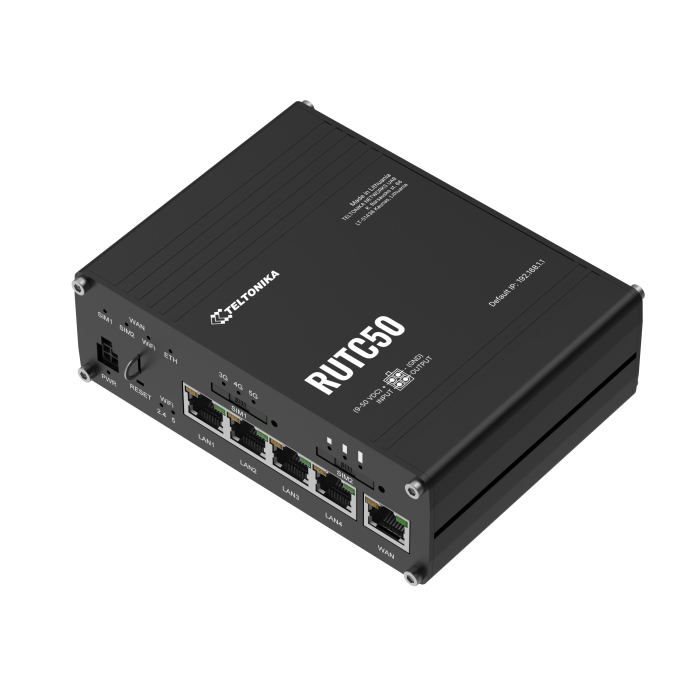
The Teltonika RUTC50 is a 5G router with dual-band Wi-Fi 6, designed for edge computing applications, global deployments, and cellular connectivity infrastructures where ultra-high throughput, advanced local processing, and flexible SIM management are simultaneous project requirements. It is deployed in mobile and fixed connectivity scenarios where the combination of 5G SA/NSA, Wi-Fi 6 MU-MIMO, and eSIM for remote activation eliminates the need for physical on-site intervention during deployment.
The cellular module supports 5G Sub-6 GHz with download speeds of up to 3.4 Gbps (4x4 MIMO) and is backward compatible with 4G LTE Cat 19 at 1.6 Gbps and 3G networks, ensuring connectivity at any stage of 5G transition. Dual-band Wi-Fi 6 delivers up to 2402 Mbps on the 5 GHz band and 576 Mbps on 2.4 GHz with support for up to 512 simultaneous connections, 802.11s mesh, and 802.11r fast roaming — suited for high-density wireless deployments. Enhanced processing resources of 1 GB RAM and 8 GB flash memory enable local edge application execution without additional hardware, differentiating the RUTC50 from standard 5G routers in this category.
Flexible SIM management covers dual physical SIM configurations (order code RUTC50 *0****) or dual SIM plus eSIM with up to 7 profiles (order code RUTC50 *1****), with configurable auto-failover triggered by signal strength, data limits, roaming, or network unavailability. The TPM 2.0 module provides hardware-level authentication and secure certificate storage, while 802.1x port-based authentication adds infrastructure-level access control. The Gigabit WAN port and 4 Gigabit LAN ports complement cellular connectivity with wired backup WAN, VRRP, and Wi-Fi WAN failover options.
Recommended for integrators and operators deploying 5G connectivity infrastructures with edge computing requirements, retail and hospitality environments with high-density Wi-Fi 6 hotspot deployments, distributed networks leveraging eSIM for touch-free remote activation, and mission-critical applications where TPM 2.0, a full VPN stack, and advanced local processing are primary platform requirements.
No questions about this product, be the first and ask your question.